
Case study · Tools / Open source
GetCIF
Public data.Developer ready.
A free, documented API that makes Romanian public company data easier to query, reason about and depend on.
- Access
- Free, documented API
- Model
- Cache / snapshot / live source
- Status
- Live
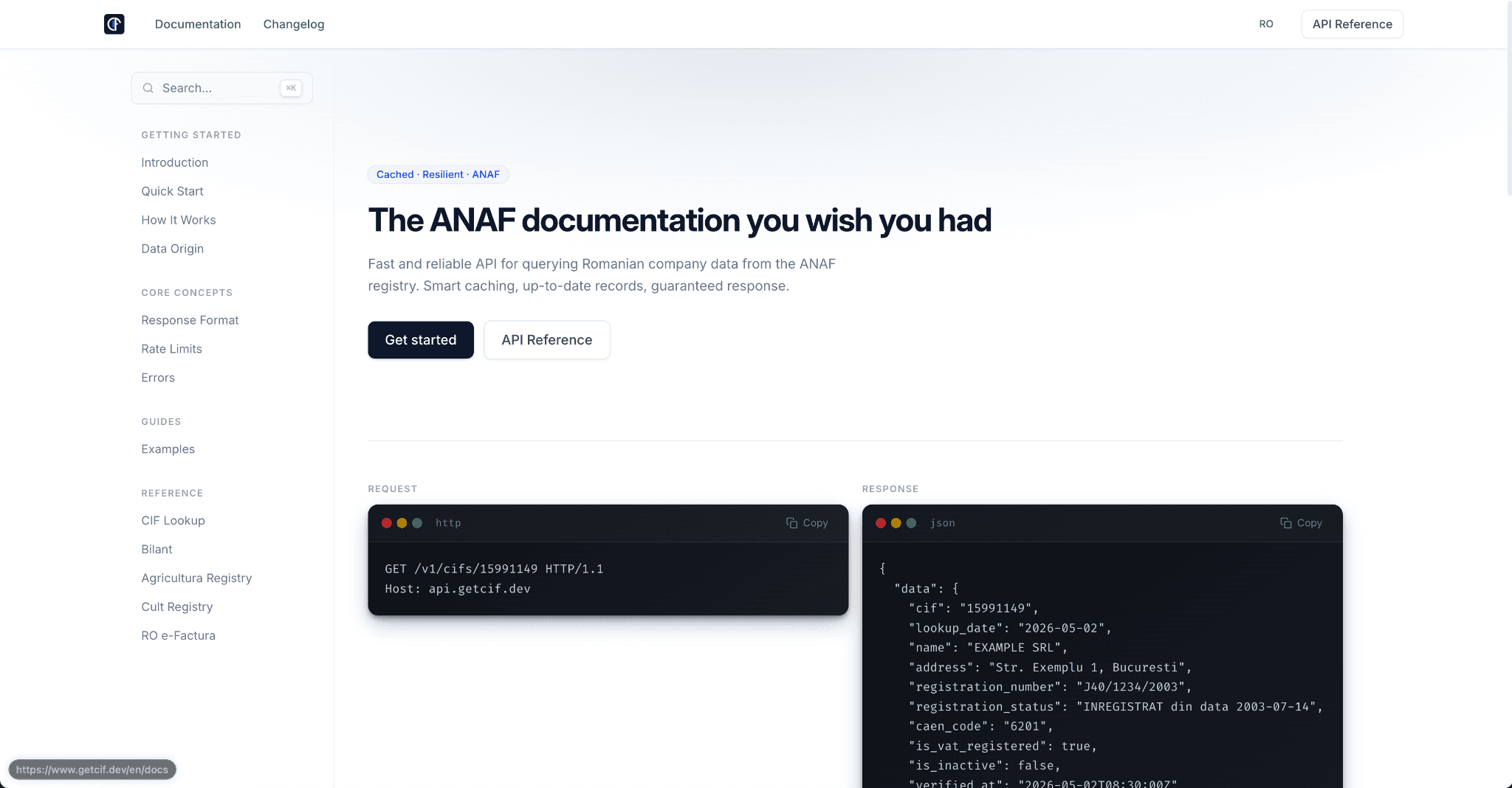
meta.data_origin → CACHE / SNAPSHOT / ANAF01 / Overview
Not another thin proxy.
GetCIF gives developers a clean way to look up Romanian companies by CIF. Behind one small, consistent API it handles validation, caching, snapshots and the public ANAF services, so an integration gets a predictable answer instead of the upstream's quirks.
It is free to use, documented in English and Romanian, and has SDKs for Node.js and PHP.
02 / The problem
The data is public. Depending on it is harder.
Company and VAT data from ANAF is freely available, but building directly on top of it means taking on every rough edge of the source.
An unpredictable upstream
The public services can be slow, rate-limited or briefly unavailable. Call them directly and each of those moments becomes your application's problem.
Input with its own rules
CIFs need normalising, personal CNP values have to be kept out, and date-based lookups need a sensible default. Every integration ends up relearning the same rules.
Payloads shaped for the source
Raw responses mirror how the upstream stores data, not how an application wants to use it, and they don't say whether the data came from a live lookup.
03 / What it does
Small surface. Clear contract.
A handful of obvious endpoints, one response envelope, and the source of every answer included in the response.
Company lookup
Look up one company by CIF, or many at once. Bulk requests keep the order you asked in, duplicates included.
Raw payloads when you need them
Each structured endpoint has a raw twin that keeps the same envelope and places the original ANAF payload in data.raw.
More than company records
Financial statements, the agriculture and cult registries and the RO e-Factura registry follow the same conventions.
SDKs and an OpenAPI contract
Typed SDKs for Node.js / TypeScript and PHP, and an OpenAPI spec for everything else.
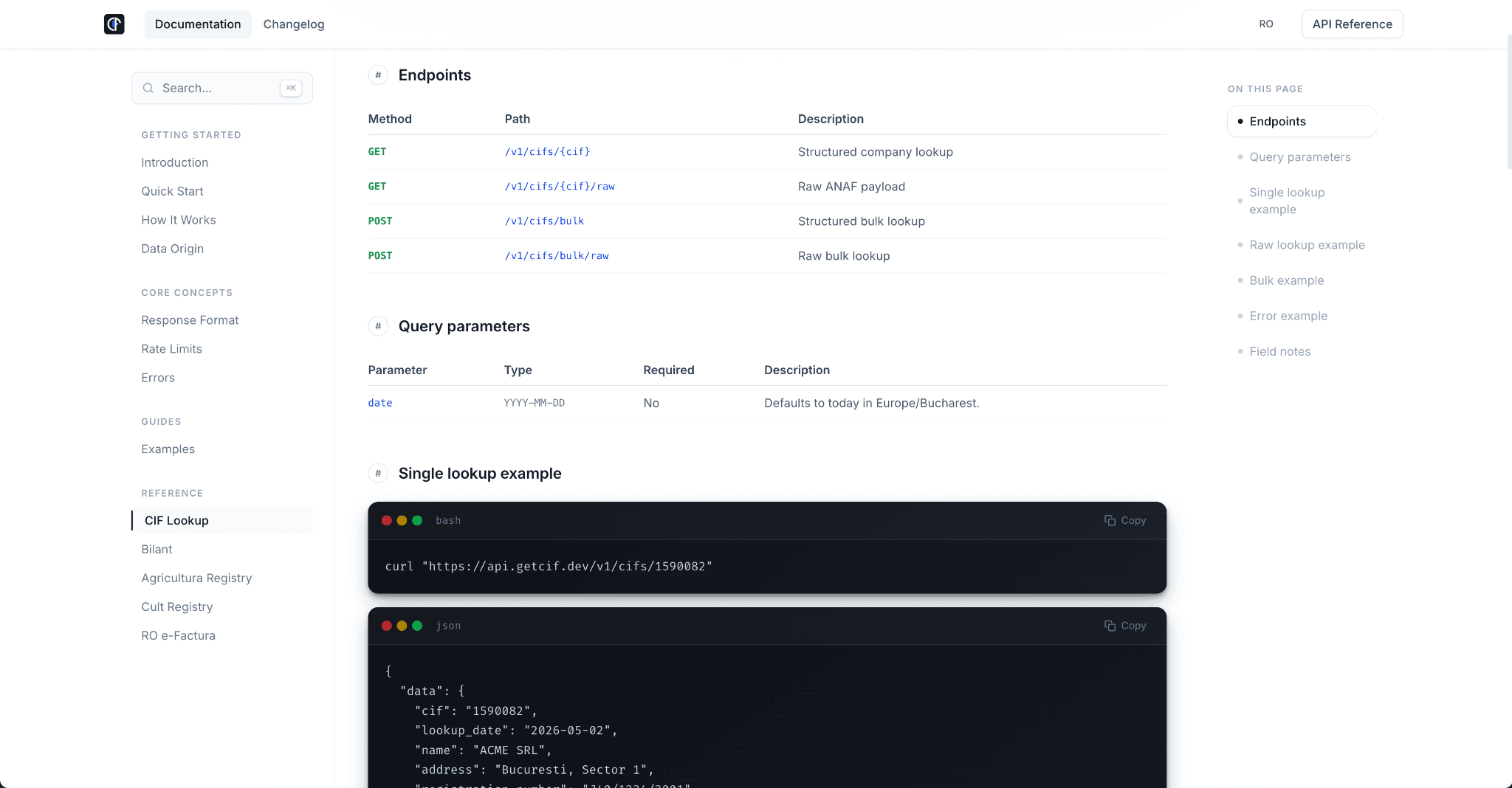
| Method | Path | Description |
|---|---|---|
| GET | /v1/cifs/{cif} | Structured company lookup |
| GET | /v1/cifs/{cif}/raw | Raw ANAF payload |
| POST | /v1/cifs/bulk | Structured bulk lookup |
| POST | /v1/cifs/bulk/raw | Raw bulk lookup |
GET /v1/cifs/1590082

{
  "data": {
    "cif": "1590082",
    "name": "ACME SRL",
    ...
  },
  "meta": {
    "data_origin": "CACHE"
  }
}
04 / Under the hood
Do the cheap work first.
Every lookup follows the same deliberate sequence. A live ANAF call is the last resort, not the default.
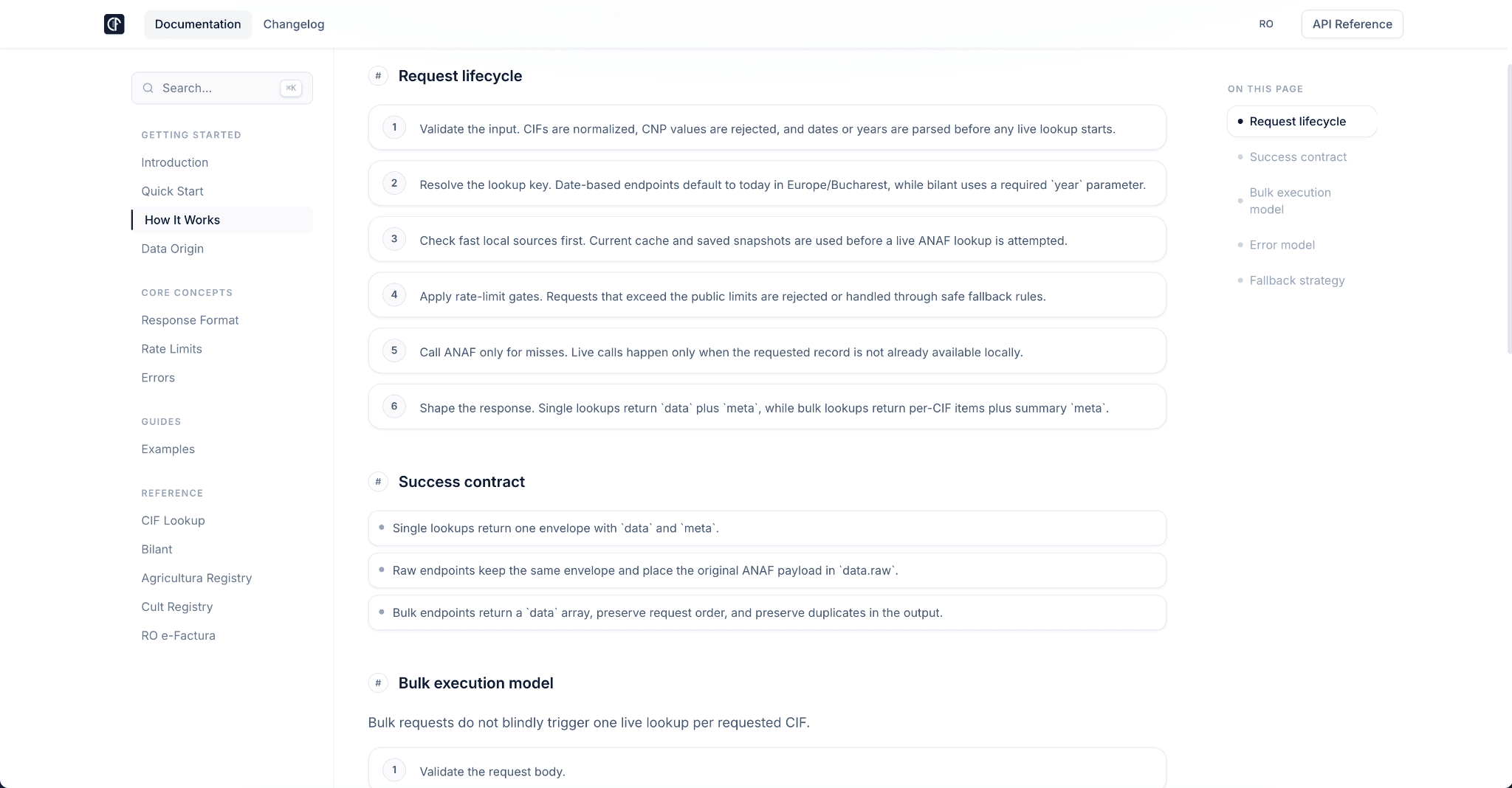
- 01
Validate
Normalise identifiers, reject CNPs and parse dates before anything touches an upstream service.
- 02
Resolve
Derive the lookup key. Date-based endpoints default to today in Europe/Bucharest.
- 03
Check local
Use the current cache and saved snapshots before considering a live request.
- 04
Gate
Apply rate limits and safe fallback rules before reaching the origin.
- 05
Fetch
Call ANAF only when the record is not already available locally.
- 06
Shape
Return a stable envelope: data plus meta, with per-CIF items for bulk lookups.
Fresh when possible. Useful when not.
Every successful response says where it came from, so an integration can tell a fast cached answer from a saved snapshot or a live fetch.
- 01 / First choiceCACHEmiss
A record already inside the current cache window.
- 02 / FallbackSNAPSHOTnot saved
A persisted record saved from an earlier lookup.
- 03 / Live sourceANAF
The upstream service, reached only when the record has to be fetched live.
meta.data_originX-Data-OriginCACHESNAPSHOTANAF
Live lookups pay forward
Once a record has been fetched and saved, later requests can usually skip the same upstream work.
Failure is designed, not leaked
When ANAF is struggling, the API can return a locally available record instead of passing the outage on to the caller.
05 / Tech stack
Plain, dependable parts.
Nothing exotic. Each piece has one job in the lookup path.
- API
- Go · chi
- Cache + rate limits
- Redis
- Snapshots
- PostgreSQL · sqlc · pgx · golang-migrate
- Contract
- OpenAPI
- Observability
- OpenTelemetry
- SDKs
- TypeScript (@getcif/sdk) · PHP (getcif/sdk)
- Documentation site
- React · Vite · Tailwind CSS
- Deployment
- Docker · Traefik · Dokploy
06 / Current status
Live, documented, deliberately small.
The scope is intentionally narrow: reliable access to useful Romanian company data, with enough caching, provenance and fallback logic to make integrations less fragile.
- API
- Live at api.getcif.dev
- Documentation
- English and Romanian
- SDKs
- Node.js and PHP · 0.1.0